Calculating is the beginning of profit
Schreurs Agro: working with the optiSCAN
The challenge
At Schreurs Agro, everything revolves around down-to-earth entrepreneurship and keeping track of figures. The company runs a pig farm with 7,400 places, combined with 75 hectares of arable farming. There are two locations: the pigs in Stramproy and the chickens in Haler, three kilometres away. Schreurs Agro supplies approximately 24,000 pigs annually.
Site manager Geert Geurts first encountered optiSCAN four years ago at a trade fair. The system had just been launched and was still experiencing teething problems. When discussions later arose about kilos and slaughter weights, he looked into it again. ‘I had seen optiSCAN before and when I got questions about weight again, I looked you up and called you straight away.’
Project goals
- Minimize the deviations at slaughterhouses and save costs
- Everyone can work with the same accuracy without having to convert
- Saving time is not the primary goal, but weighing with the optiSCAN doesn’t take any extra time.
Reducing cost savings and weight discounts
The reason for starting with optiSCAN is crystal clear to Geurts: cost savings. He sees that slaughterhouses benefit from slaughter weight deviations through discounts. ‘Slaughterhouses earn money from weight discounts, so I wanted to minimise the deviations.’ Before the introduction, high weight discounts were a recurring challenge, especially around the end of the year. ‘The slaughterhouse always shifts, and that ultimately costs you money.’
Objective after implementation: maintain an average slaughter weight of 97 kilograms and deliver neatly and consistently every week. ‘If you have a second slaughterhouse available, you can keep parties alert and maintain sales levels.’
I had seen optiSCAN before and when I got questions about weight again, I looked you up and called you straight away.
Geert Geurts
Purchase and implementation: on-site training and verification
The process was straightforward: contact by email and telephone, followed by a presentation and training on site. Verification with scales was crucial. ‘We re-measured the results and found a deviation of approximately three kilograms, which translates to about two per cent at 120 kilograms; that gives me about 98 per cent certainty.’
Geurts has a clear wish for the software: ‘I would like to be able to set the fixed deviation in the device so that everyone, even when I am on holiday, can work with the same accuracy without having to convert.’ He also wants to be able to see how accurately the weighing was done: ‘That way, I can verify and confirm that I did it right.’ Cooperl is already looking ahead: developments for 2026 are in full swing, and these points are part of that.
In the barn: learning by doing and certainty in selection
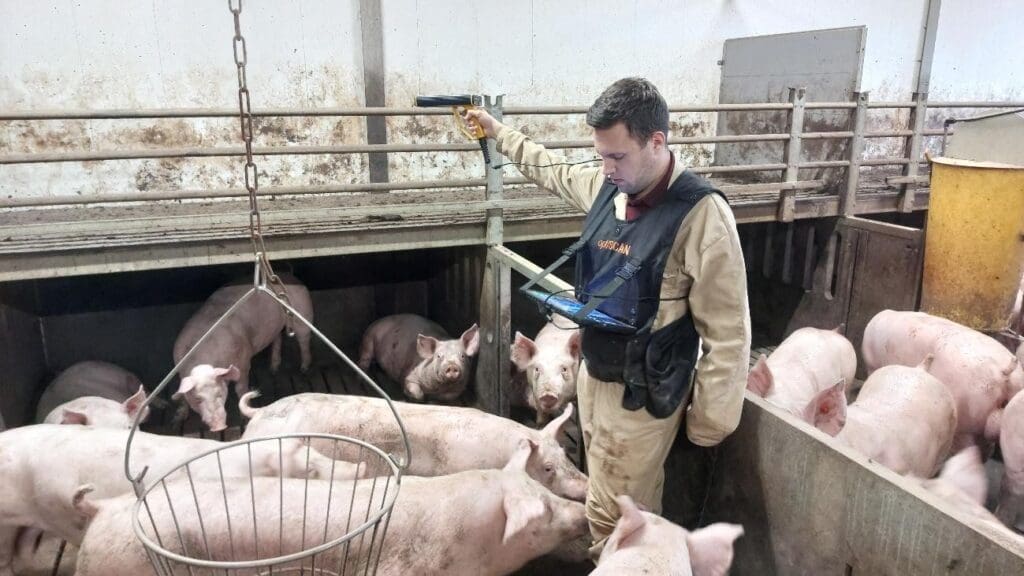
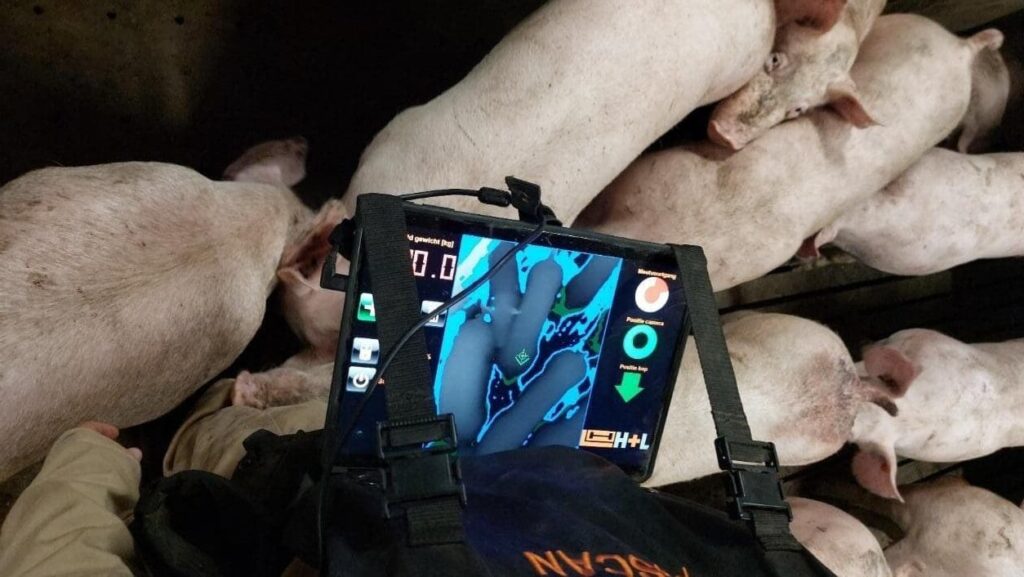
The first few weeks take some getting used to. ‘You have to get the hang of optiSCAN, but after three to four weeks you really get the hang of it.’ The practical work rhythm is clear: charge the system weekly, go into the barn, and scan while marking. ‘I can easily mark two to three hundred pigs per hour, of which about 60% are weighed, and I focus mainly on the doubtful ones and the frontrunners that are just heavier.’
The biggest gains are in certainty and more consistent selection. ‘With optiSCAN, I no longer have any doubts: it’s either good or not good; I make a mark and the animal can leave.’ The software helps with this: ‘I can clearly see in the software on the tablet how well the animal has been weighed, and that gives me confidence.’
In the barn: learning by doing and certainty in selection
Geurts carefully calculates the business case. ‘You earn back your investment in one year.’ With an average slaughter weight of 97 kilograms and a 2 cent reduction in weight discount, he estimates savings of approximately £55,000 per year. ‘That’s a lot of money, and you see that reflected across all pigs.’
The position is also stronger towards the slaughterhouse. ‘We keep strict records here, and if there is a difference, I see it immediately and can report it to the slaughterhouse.’ A discount of zero is rare. ‘You don’t really get below 0.3 pence, but there are weeks when it’s almost zero.’
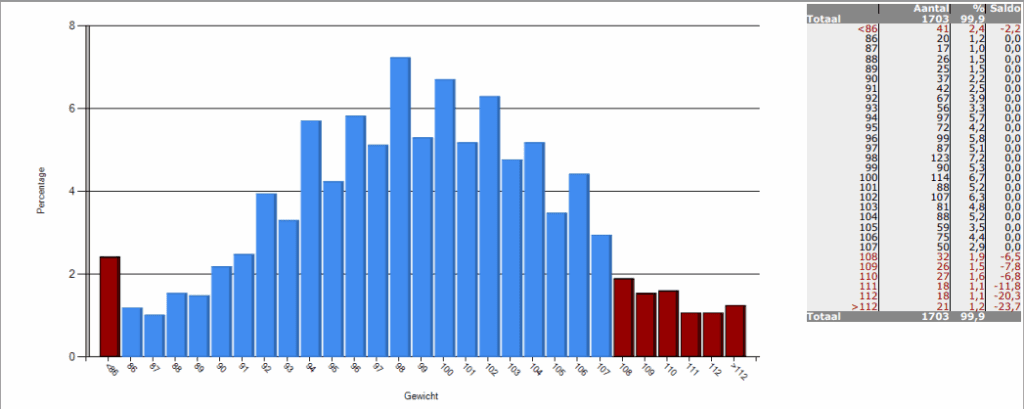
When looking at the results, the effects are clearly visible. In a period in which 1,703 pigs were delivered without using the optiSCAN, 41 were underweight and 142 were overweight. This amounts to 10.7% of the total, with a total weight discount of £1,931.74, or approximately £1.13 per pig delivered.
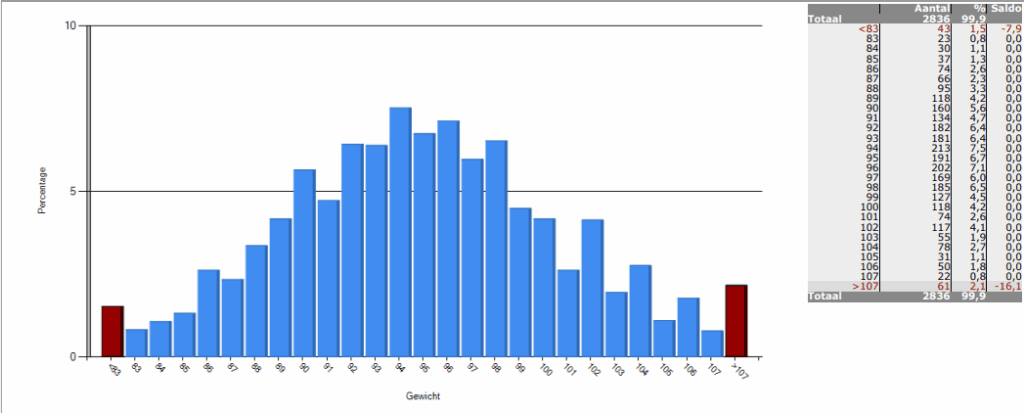
In a comparable period in which the optiSCAN was used, 2,836 pigs were delivered, of which only 43 were underweight and 61 were overweight. This is approximately 3.7% of the total, with a weight discount of £1,339.22, or £0.47 per pig delivered. This represents a 58.4% reduction in weight discount, clear evidence of the effect of the optiSCAN.
When you see what happens, you understand how quickly you save money with optiSCAN.
Geert Geurts
Overview of weights and discounts
The graph shows how the weights of the pigs are distributed. The blue values represent the pigs that fall within the desired weight range, while the red values represent the animals that are too light or too heavy. The table next to “total” shows the weight of the pigs and the column next to it shows how many pigs fall into each weight category. The “Balance” shows the discount (in pence) that the slaughterhouse charges when a pig is outside the ideal weight range. A balance of 0.0 means that the weight is exactly right.
Weight without optiSCAN
Weight with optiSCAN
Time and efficiency: no extra work, but less uncertainty
Saving time is not the primary goal, but weighing with the optiSCAN takes hardly any extra time in practice. ‘You have to go into the pens and mark them off anyway, and with the optiSCAN you can do both in the same operation, so it doesn’t take any extra time.’ The elimination of uncertainty during selection speeds up the selection process for the pigs to be delivered.
People and discipline
Discipline is important to Geurts. ‘If you work seriously and really want to earn money, you get the most out of it; don’t bother if you’re only going to do a half-hearted job.’ He manages the herd largely by himself and keeps meticulous records of the selection. ‘If you work accurately, optiSCAN pays for itself many times over.’
Advice to fellow farmers: calculate, compare and remain consistent
The core message remains unchanged. ‘Calculate the figures and check everything carefully, especially the slaughter invoices and where the discounts are.’ According to him, any reservations about 3D scanning disappear as soon as people see it. ‘When you see what happens, you understand how quickly you save money with optiSCAN.’
As branch manager, he summarises his approach. ‘The first thing I look at is what’s on an invoice and how I can ensure I pay less, because that’s the first profit.’ In combination with his own feed and consistent use of optiSCAN, he wants to raise pigs at a structurally lower cost price.